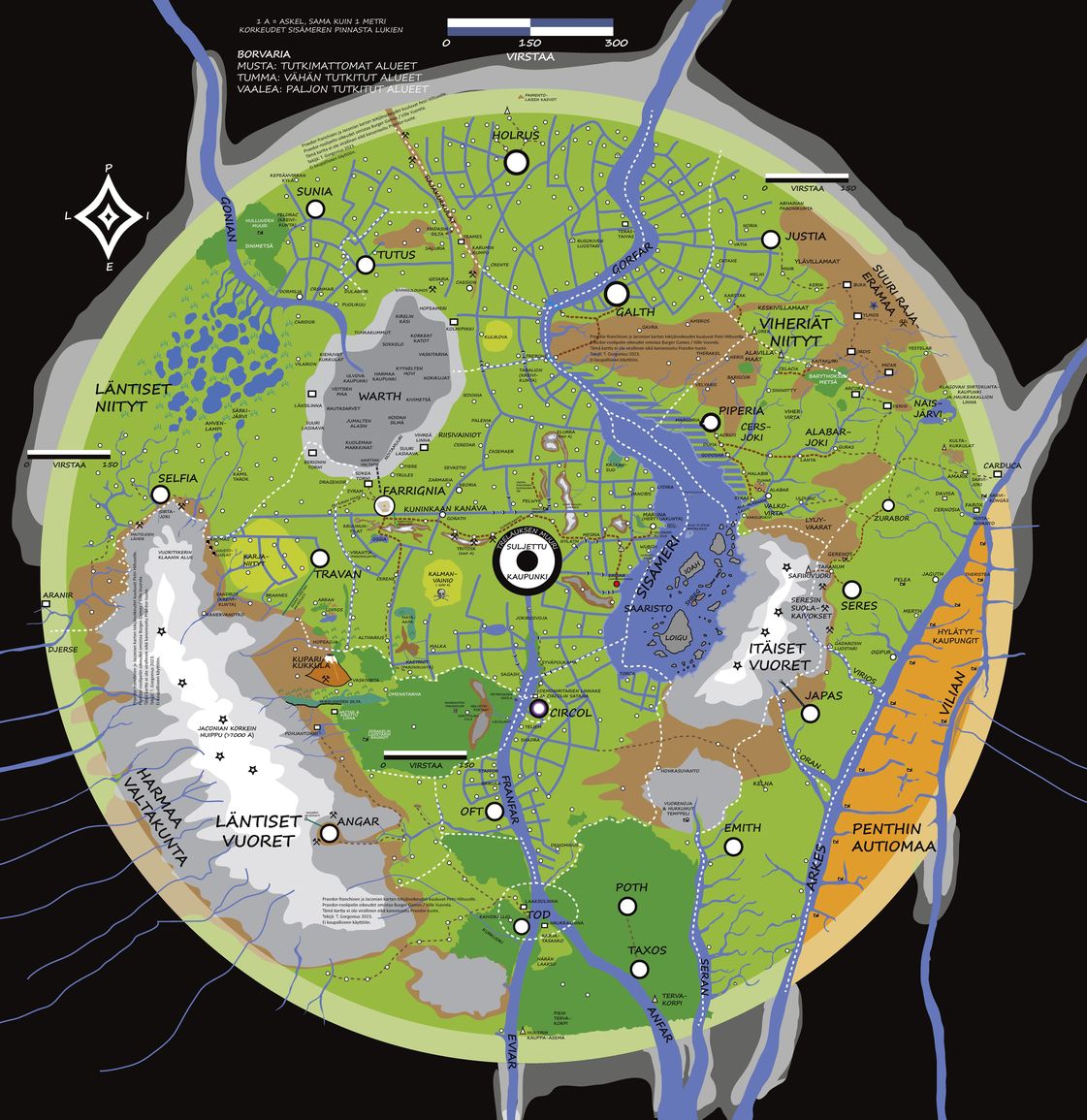
It is not known whether Jaconia belongs to the past or the future. In some dimension of eternities it just is. Jaconia is a large circular area of free land amidst the remains of a long-dead dark culture. Jaconia consists of nineteen city-states and several loose tribes. Of the cities the Closed City is the largest, of the city-states Farrignia.
Jaconia is surrounded by Borvaria, the realm of death, an ancient city of ruins spanning millions of square kilometers. No one knows what lies beyond Borvaria. Some religious groups believe that there is nothing. Borvaria is a place of death. An eternal dark power and nameless creatures make it a dark hell.
Praedors are adventurers who make a living by looting precious items from the ruins of Borvaria and Warth (although less). Difficult and dangerous. — from "Love is in the Air" comic, Petri Hiltunen, 1988
This document aims to describe the Praedor-franchise for those poor people that are not fluent in Finnish, the Happiest Language in the world. — T. Gorgonius, 2026
Years ago, at some book publishers' meeting, Ville Vuorela's publisher at that time claimed: "Praedor is the Biggest Fantasy Brand in Finland". To that, Vuorela commented: "Shouldn't that be Moomins?" The Moomin representative, blushing slightly, stood up and proclaimed: "Moomins are not fantasy!" Thus, Praedor was officially declared as the Biggest Fantasy Brand in Finland by Moomin Characters Oy Ltd herself.
Originally, Praedor was a series of comics written and drawn by Petri Hiltunen (Instagram), which he drew for about 40 years. First comic was drawn in 1985, and the final album, Varjo menneisyydestä (Shadow from Past) was published in 2025. What would become the most popular Finnish tabletop roleplaying game, named Praedor, was written by Ville "Burger" Vuorela in 2000 and published by his company Burger Games. 2nd Edition was published in 2020.
So far, the franchise has six comic albums, seven novels, five short story collections, a cookbook and an unofficial "Life hacks" book for Jaconia. These are written by several writers who were fans of Praedor. Some of these have Hiltunen's art, but he himself hasn't written novels nor short stories.
At the moment, there is a Finnish Wikipedia page: https://fi.wikipedia.org/wiki/Praedor and praedor.net pages, likewise mostly in Finnish. There you can read a set of three short Praedor comics in English: "A Tale of Three Sovereigns" ("Kolmen valtiaan tarina"). Vaskikirjat is one of the most important publishers of Praedor novels and anthologies.
Praedor tells about a post-apocalyptic fantasy world called Jaconia. It is a round area, roughly two thousand kilometers across, surrounded by an immense, ancient and cursed city of rampant monsters and undead, unstable dimensional portals, wild magic—and ancient artifacts and treasures. Borvaria was once ruled by powerful Wizards. Nobody, including themselves, knows where they came from. The Wizards are immortals, but have to use a special immortality serum which is vital to their existence.
A massive catastrophe tens of thousands of years ago destroyed Borvaria, leaving only the magically shielded area, called Jaconia, intact. Wizards brought surviving life forms and plants into Jaconia, developed numerous new life forms, and the six Wizard-Kings ruled over lesser Wizards and humans for thousands of years.
After the catastrophe, Jaconia was divided among six Wizard-Kings. First and most powerful was Remus Thesioporus, who brought artists and musicians to his city, Tulath, in the exact center of Jaconia. When he got bored with them, he simply killed them and brought in more. But he led the Council with an iron hand and he was responsible for the great magical crystal which shielded Jaconia from the wild magic.
Second among them was Kirel Curarim, the ruler of the great city of Warth. He staxrted to imitate the ancient culture and even started secretly teaching magic to mortals and giving them the immortality serum roughtly 300 years before the current era (VT, Valiar's Time or V.a., Valiarin aika, in Finnish) began. Only descendants of Wizards should have been allowed to take the serum. Finally, he started experiments to combine humans and demons, for even more power and the ability to travel to other worlds. This was one of the reasons the ancient realm fell and thus he endangered the entire remaining land.
37 years before VT, Warth was at the brink of collapse, and the curse was spreading outside of the city. The other Wizard-Kings and their armies besieged Warth from every direction, eliminated all life and wild magic, and finally burned everything down. From that time, Warth has been dead, silent and almost completely empty. Nobody knows what happened to Kirel Curarim. Not a single image or statue with his face exists. There are artifacts remaining in Warth, but they are extremely hard to find. The first praedors, professional artifact hunters, started by exploring Warth after its destruction.
Third was Vortan Aranos, the only one of Wizard-Kings that was considered relatively good. He developed agriculture and tools, and built most of the channel network in the Central and North Jaconia. His servants fought on his side later in the civil war. For revenge, rebels destroyed his city, Holrus.
Fourth was Eman Valloi, Wizard-King of Piperia and the Inland Sea. He declared himself as a deity, and his realm was built upon his cult. Many of the dogmas and practises of this religion were later copied to the Church of Artante, the current major god of Jaconia. Other Wizards never admitted his divinity.
Fifth was Palak Velador, an eager student of life forms. He used thousands of slaves and animals and experimented with them. Some died, and some became monsters. He released so much of them that the southern woods became so dangerous that not even Wizards dared to go there without guards. Most of the wild beasts and domestic animals were created by Palak Velador.
Sixth was Arel Hiramon, also known as the Necromancer. He cared more about ghosts and machines than people. His court was under great fear, and he used even other Wizards in his experiments. His rebelling slaves became the mountain barbarians. Hiramon sent soldiers, assassins, monsters and undead against them. This only made the barbarians stronger, and their warrior clans are legendary. Hiramon is gone, but they still fight the monsters.
Near the last civil war which, the Council selected seven Wizards trained in ancient arts of combat as their protectors. They were given new names, their bodies were closed into a black glass -like armor, which cannot be taken off except for the helmet. Their new names were Caelan, Cesaran, Trelaus, Verna, Cadar, Aerac, and Marran.
The Wizard's Council demanded the Wizard-Kings to step down and start obeying the Council. The Wizard-Kings refused, the Wizards—society was divided to King's—and Council's supporters.
The Council did not have an army but they started training and recruiting mortal slaves. They did their best to get good officers and leaders, and promised their freedom. The Wizard-Kings feared a world-wide uprising and committed terrible atrocities to prevent it. This only drove the last of the doubters to the side of Council.
The Demon Knights sided with the Council and would be the model for all mortal knights in future battles. At year 12 before VT the Council formulated its decision, according to which wizards would share secular power and court positions with mortals in return for their help. Those who refused would be forced to comply, even by force. The smoldering spark burst into flames.
The mightiest Wizard-King, Remus Thesioporus began murdering Wizards and council members, who wanted the Wizard-Kings to step down. The Council had also decided that human kings should rule humans and Wizards would retire to their own place. Wizard-Kings were murdered mostly by their own servants. They were immortal, but not immune to an assassin's knife in the back.
Remus retreated to his own city, Tulath, at the very center of Jaconia. No army would be able to conquer it. He realized the ancient realm could never be restored and became insane. He let an extremely powerful demon to possess himself and attempted to destroy the great crystal in the center of Tulath. This magic crystal was the thing that protected Jaconia from Borvaria.
He wanted Jaconia to be destroyed. To destroy the crystal, he needed to leech the life energy from all of his citizens. When the opposing army died, this allowed the Demon Knights, a group of soldiers whom the Wizards had given immortality, to move into the city.
They killed Remus before he finished the spell, but the possessing demon moved from the dying Wizard-King into Cesaran, the leader of the Demon Knights. The others managed to place the Amulet of Manatir on his neck, which immobilized the demon and prevented it from using its power. They left the demon in that state and retired from the city. Wizards then spend 30 years to build an impenetraple wall around Tulath. This wall is called Trelaus' Wall and Tulath is now known as the Closed City.
Wizards retired into their own city, Circol, and made an agreement with mortals. They would not meddle in their affairs and vice versa. Human king would rule the rest of Jaconia. The First King, Valiar Mada, failed to convince the other realms, Holrus in particular, under his rule. Jaconia was divided into several kingdoms, city-states and countries.
The realms, starting from the north and going in rows from west to east, are Holrus, Sunia, Tutus, Galth, Justia, Western Swamps, the dead ruins of Warth, Piperia, Selfia, Travan, the Inland Sea, the Eastern Mountains, Seres (or Crying East), the Western Mountains, Circol Forest, Circol the City of Wizards, Hills in between Eastern Mountains and Southern Forest, Japas (of Crying East), South part of the Western Mountains, Angar, Oft, Northern part of Southern Forest, Emith (of Crying East), Wastes of Penth in between river Arkes and Vilian, and then Tod, Poth, and Taxos in the Southern Forest.
The biggest kingdom is Farrignia in Middle Jaconia. Its kings were direct descendants of the First King, Valiar Mada. Second strongest is the theocracy of Holrus in Northern Jaconia. Other central states include Sunia, Tutus, Selfia and Travan. A great network of canals, built mostly by Wizards long ago, covers almost the entire area.
North of Farrignia is the great ruined city, Warth, where Wizard-King Kirel Curarim tried to recreate the great ancient realm of immortals. It endangered the entire remaining lands, so other Wizards besieged the city from all directions, destroyed all monsters and dimensional gates, eliminated the wild magic and finally burned everything they could. Now Warth is silent, dead, and almost completely empty.
To the east of Farrignia is the Inland Sea, a great freshwater lake. From Inland Sea, the wide and slow-flowing River Gonian flows north through Galth and Holrus, and finally into Borvaria. Southeast of the Inland Sea are the Eastern Mountains, where mountain barbarians live in the valleys. They are proud people, who often raid nearby farms and villages.
At the very centre of Jaconia is the Closed City, once named Tulath, surrounded by the impenetrable Wall of Trelaus. The last great battle of the civil war was fought here. Fresh water flows perpetually out of the Closed City, contributing to the great river Franfar. Near Tod, this river divides to tributaries named Anfar and Eviar. This kind of bifurcation is unnatural, and one of the proofs that Jaconia is mostly artificially created.
In the mountain- and forest-covered Southern Jaconia are kingdoms of Angar and Oft, the Wizards. City, Circol, and the free states of Oft, Tod, and trading posts: Poth and Taxos, deep within the South Forest.
The Crying East is a land poisoned by great river Arkes, which flows from Borvaria through the area, and finally back to Borvaria in the southern edge of Jaconia.
The Wolf Desert, roughly 50 kilometers wide, surrounds Jaconia in a complete circle. The outer edge of this area is Borvaria. The Nomad barbarians, such as the tribes of Tarai, Saramani and Varna, live in this borderland.
To the southwest rise the great Western Mountains, the highest in Jaconia. Kingdom of Angar is located in a large mountain valley. Mountain barbarians live around the mountains, likewise in valleys.
The major god of Jaconia is Artante, whose holy books were collected soon after the civil war ended. His most important dogma is that every man is born into a certain social class, and should remain there for his or her entire life. Everyone must respect and obey those of higher status.
He is a stern god. Only men, living in celibacy, can be his priests. Women who want to serve Artante can enter a womens' monastery, as can men. Male monks are called monks, but women in cloisters are "light maids". Male monks have more freedom, though less than a free man or a knight.
Artante's faith includes many widely known and even more local revered figures: these are the Blessed, the Heroes, and the Martyrs of Artante. Each one has their own designated day. One of the Heroes is Valiar Firstking.
There are two other popular gods: the gentle Tiraman, Lord of Birds. Anyone can be his priest. Worshippers periodically dress in grey, are called Grey Brothers or Grey Sisters, and do charity work.
The other is Twin Mother, the dual goddess of the nomad barbarians. He's half white (day) and half black (night). Her worship varies quite a bit. She's revered by many peasants as well - they think "it's better to respect this god too, can't be too sure".
There are rumours about gods of the depths of the Inner Sea - and rumours about the Islanders worshipping them. These ancient beings may require human sacrifice.
The most important king in Jaconia is the king of Farrignia. They have so far all been direct descendants of Valiar Mada. Below the king, the are Dukes, Counts, Marquises (same as "Border Count"), Barons, Knights, free men (such as craftsmen), peasants, merchants (socially low but powerful because of their wealth), beggars, and lowest of the low (bandits, forest barbarians).
Thousands of years of suffering in slavery during the reign of the Wizard-Kings, and later in Warth, had a profound influence on the fact that, in the Peace of Valiar, serfdom and slavery were outlawed for both humans and Wizards alike. Only in the East, beyond the mountains, the local tyrants don't care and have slaves.
And finally, we get to praedors. They are feared, but also romanticized and source of many legends. The most famous of them is Ferron (the main character of the original comic books). Praedors travel to the edge of the world and enter Borvaria, the cursed land of monsters and wild magic. In there, they explore the ancient ruins for artifacts, and valuables such as jewelry, gems, and gold. Death lurks behind every corner, and during the night hordes of nameless monsters come out to hunt. Every plant, fruit and all water is poisonous to humans.
Most often praedors are people who have fallen out of their social class for some reason. Some had to flee from their home and had no other options but to become a praedor. Some committed a crime and fled. Praedors are outside the entire social hierarchy. But since they bring back items sometimes of extreme importance or immense value, they have certain freedoms by the law. They are excempt from tariffs and city entering fees. But they cannot own land nor they can testify at court.
Praedors are also hired by Wizards, rich people, nobles and the universities for various tasks, not always involving Borvaria, because praedors are tough and resourceful, and suitable for many difficult tasks. People who have survived a trip to Borvaria and back, or several trips, are extraordinary. The best fighters among mortals are found amongst them, and also the most cunning thieves.
NOTE: a few details (such as Guild Football, names of the first and second daughters of Teniran, etc.) have not yet been approved by Petri, but most of this section can be considered canon.
In 482 VT, Teniran Mada became the king. He was very handsome and strong, and was hugely popular at first. Gradually, he began to change and make weird decrees. In later 480s he decided that women should also be able to attend university and Lazira Hyros became the first female student. This was unthinkable and a great scandal, for nobody had seriously even thought about it before. Along with never reinstituting slavery, that was one of the few beneficial things he did.
When his wife, Anti, died mysteriously in 490 VT, no one could restrain his madness anymore. At the same year, king married his oldest daughter, Ledella. It was against all the laws and a great sin according to Artante's church, but the king did not need to obey any laws.
Those who spoke against him and got caught, were tortured in many clever ways the Mad King could come up with, and usually in public. He sponsored chariot races, the violent "Guild Football" (somewhat like Calcio storico fiorentino), gladiatoral shows where political opponents, convicted criminals and—just for his sick enjoyment—women fought against each other or beasts. At the events he distributed bread and ale to the spectators for free. Thus, the king was hugely popular among lower class citizens. Also, the powerful Palace Guard (comparable to the Praetorian Guard of Ancient Rome) was always fanatically loyal to the king, no matter what, and the king was sane enough to treat them well.
The king had his only son, Saeras, executed at 491 VT. He was accused of treason. He might actually have been conspiring against his father. He was beheaded with the sword, which is viewed as a honorable way of death. Usually the king used much more creative (and slower, more painful) methods.
In 492 VT, he had gotten bored to his daughter-wife, and let her to put into a body-shaped cage and hung it up in public until she died. It took fourteen days, because it rained one day and she got a drink of rainwater. While she was still wailing in agony, Teniran Mada married her second daughter, Lokea.
His second wife—his second daughter—lasted her in "marriage" only three months, until she committed suicide by jumping from the window of king's high tower. The king felt betrayed, because "she should have asked me to kill her, not to do it herself!" At that autumn, the king married her last and youngest daughter, Liala.
Liala Mada afterwards said, that "our wedding was beautiful". And it was, the king saved no expenses to celebrate his latest "conquest", her youngest daughter. He then subjected her to all sorts of sexual depravity he could come up with. When the winter came a few weeks after, the king died in his sleep. Liala Mada was now the only remaining direct descendant of Valiar Mada. She seized the throne and became the first ever Queen of Farrignia.
First, she arranged a grand funeral to her father. Liala Mada was officially crowned in 493 VT. She turned out to be a skilled and intelligent ruler. She overturned most of his father's decrees. One of the first thing she did was to build her own statue, greater than any of the past kings. She said. "The monarchs with the biggest statue will be remembered the longest". She strictly upholds the status quo and the hierarchy. She is harsh and demanding, but nothing like her father. Gladiatoral games were banned, and while executions are still often public, they are now only by decapitation or hanging.
As of 521 Valiar's Time, Liala Mada is still the queen. She never married and might be too old to have children already. She has not spoken anything about getting or selecting a heir, and nobody dares to ask.
The rest is unofficial as yet.
One of the decrees the queen did not overturn was that female students could still attain university. In 513 VT, there were more female students than ever before.
The current rector of the university had recently passed away. The queen ordered Lazira Hyros to be appointed as his replacement at 513 VT. This caused an outrage. So the queen made a concession to the theological faculty: they would be lead by the vice rector and he would be a man. This was just queen's clever tactics. She knew priests would not accept a female rector and had planned this "concession" beforehand.
There are no canon translations for many terms yet. Update 2026-06-03: added a few new terms that have become part of canon. Update 2026-05-02: Translations revised with The Tale of Three Sovereigns.
| Term used | Finnish | Variations |
|---|---|---|
| Demon Knights | Demoniritarit | — |
| Philose (TG) | Filoosi | Scholar, usually a former university student; term is often used derisively to describe scholars who pretend to know a lot. |
| Guild Football (MH) | Kiltapallo | First coined by Martti Huusko. Resembles Calcio storico fiorentino. |
| Islanders | Saarelaiset | — |
| Mountain clans (3S) | Vuoristolaiset | Mountain people |
| Nomads (3S) | Paimentolaiset | — |
| Whisper, The (SP) | Arokuiske | Sign language of nomads. Literally it would be "Steppe Whispering". Appeared first in the novel "Uponneen jumalan uni" (The Sleep of the Sunken God, by Sakari Peuranen, 2018). |
| Wild Folk | Metsäläiset | Forest people |
| Wizard | Velho | Sorcerer (VV), Ageless (3S), Immortal |
| Name | Finnish | Variations |
|---|---|---|
| Barred City, The | Suljettu kaupunki | Forbidden City, Closed City, Tulath |
| Black Room, The (3S) | Musta huone | — |
| Blue Shield Quarter, The (3S) | Sinisen kilven kortteli | Ihmeiden katu, Myrkynkeittäjien kuja |
| Green Fields | Viheriät niityt | — |
| Inland Sea | Sisämeri | Inner Sea (TG) |
| Quarter of the Iron Rooster, The (3S) | Rautaisen kukon kortteli | — |
| Wolf Desert | Suden autiomaa | Wolf Waste (VV), Wasteland of the Wolf (3S) |
Writers:
VV = Ville "Burger" Vuorela
3S = The Tale of Three Sovereigns
SP = Sakari Peuranen
TG = T. Gorgonius
MH = Martti Huusko
Anything not credited to someone else is written by Petri Hiltunen.